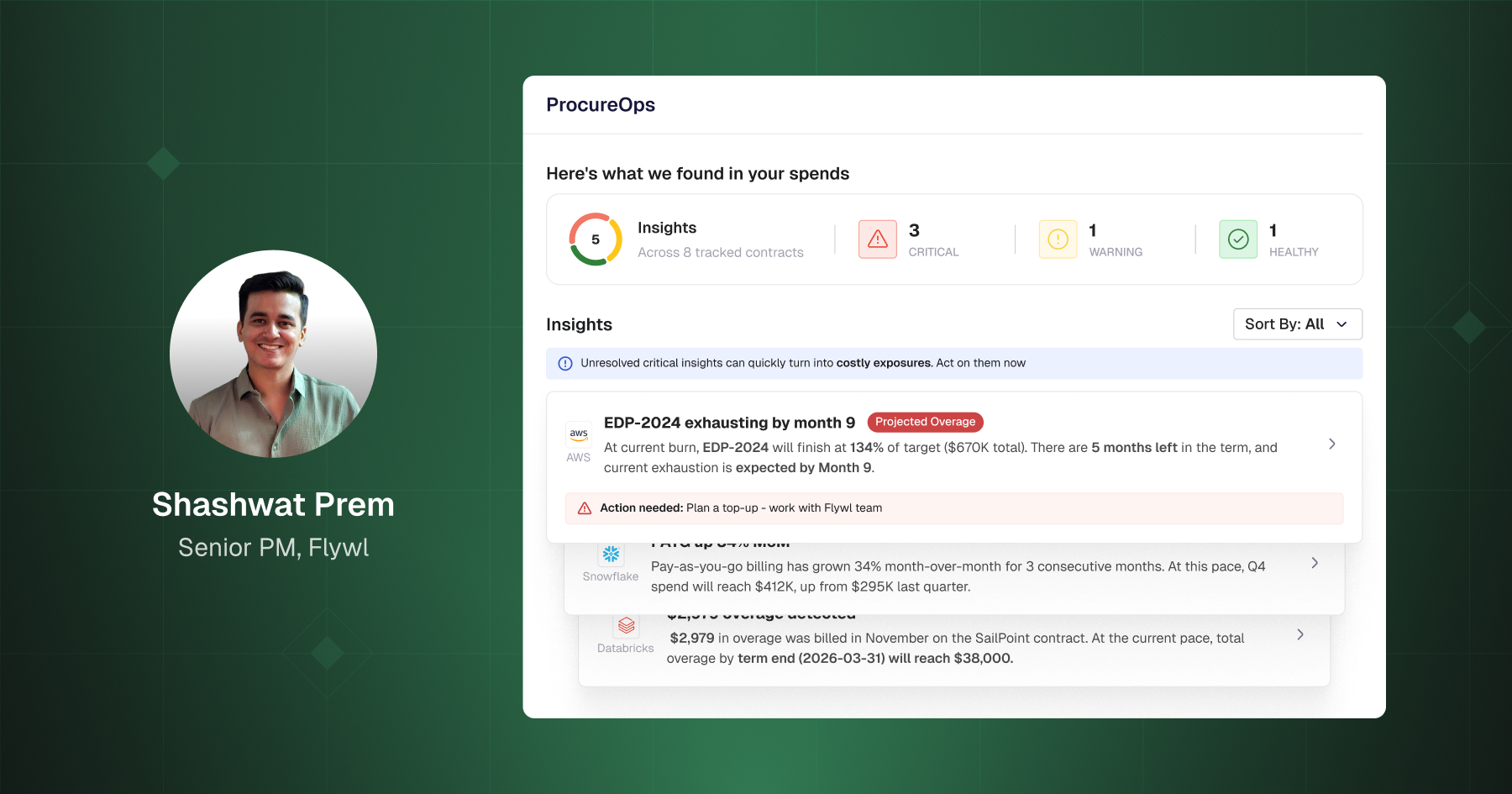
Your Cloud and Software Spend Just Got a Brain: Introducing ProcureOps

Consumption-based pricing now dominates cloud and software, and most procurement teams are flying blind because of it.
On the surface, it makes sense: pay for what you use. Procurement teams commit to a consumption level upfront to lock in the best unit economics.
But consumption-based pricing has a major downside: surprises.
Too often, companies discover cost overruns or shortfalls at renewal time — when it's already too late to do anything about them.
In scenarios where there is an overrun, a company had budgeted $X million in consumption, only to discover they've blown past that by a significant multiple. Now they're staring down a bill they didn't plan for, at a usage level that has caught procurement unprepared.
At that point, procurement is handed an almost impossible task: negotiate a retroactive discount on costs that have already been incurred and better unit economics on a higher usage level going forward.
Shortfalls have problems as well. Companies are committed to pay for consumption they haven't used, and procurement is left scrambling to roll unused credits into the next contract, with no guarantee the vendor will agree.
In either scenario, procurement is caught off guard, negotiating from a position of weakness with little or no leverage.
There is a better way.
The real opportunity isn't negotiating down the cost of an overrun; it's avoiding the overrun altogether.
That requires tracking consumption against commitments in real time. When usage starts trending above plan, procurement can engage the product owner early to move to a higher consumption tier or bring usage back in line. The conversation happens proactively, not after the fact.
That's exactly why we built ProcureOps, self-correcting spend that turns raw usage data into decisions you can act on before renewal.
"Procurement shouldn't find out about an overrun at renewal. That's the moment you've already lost your leverage. We built ProcureOps so teams can see it coming, act early, and negotiate from strength, instead of surprise." — Ankur, Founder & CEO, Flywl
Here's how it works:
One View of Your Consumption
ProcureOps consolidates and visualizes cloud and software usage data in a single place for procurement. Typically, this information is either unavailable or scattered across cloud, IT, line-of-business, and finance teams.
Initially, ProcureOps will incorporate AWS CUR files (Cost and Usage Reports) to get the data on consumption for AWS as well as any software being used on AWS. ProcureOps is in the process of capturing information from other hyperscalers and usage data from ISVs for the most granular and up-to-date information on consumption. The visualization dashboard gives procurement a clean view of consumption across products and services. No more hunting through spreadsheets or chasing down the product owner.
Insights, Not Just Data
Raw data alone won't save your budget, analysis will. ProcureOps goes beyond telemetry with an intelligence layer to tell you what the data actually means. It tracks usage against your commitments, projects where consumption is heading rather than just where it is today, and filters out the noise so only the deviations big enough to change a budget reach you.
A Prioritized Action List
Insight is only useful if it drives action. Rather than just a dashboard to watch, ProcureOps gives procurement a single prioritized view of the contracts that need attention and what to do about each one.
Every flagged issue comes with a recommended next step: a conversation with a product owner, a usage-reduction plan, or a contract renegotiation. The goal is always the same; get ahead of the problem before it becomes a crisis.
And ProcureOps keeps getting better (and smarter). As data streams from additional software vendors and hyperscalers come online, procurement will have an increasingly complete picture of their contracts and consumption. This ensures they can make better-informed decisions that save real money.