
Inside ProcureOps: from reactive to proactive procurement
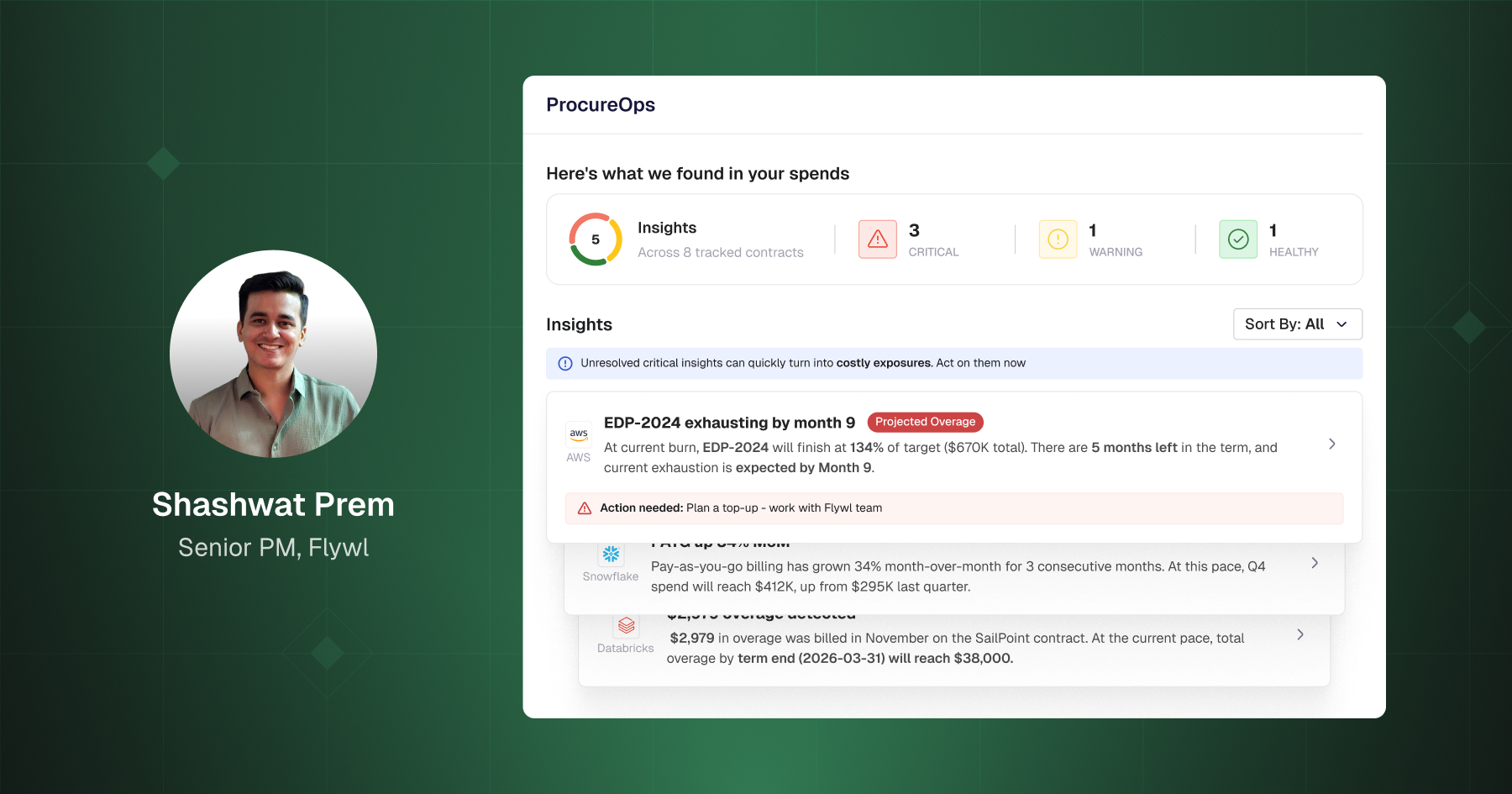
In our last post, we laid out the trap. Consumption-based pricing looks reasonable. But when the renewal comes, procurement is surprised to find out how the commitment actually played out. Sometimes this surfaces as a cost overrun: procurement sees a bill far past what was budgeted, with no leverage left to negotiate it down. While in some cases there’s a shortfall, procurement is paying for consumption that was never used and scrambling to roll the credits into the next contract. Either way, the root problem is the same: a commitment nobody was watching, left to drift until the spend came knocking.
Take a concrete case. Company A signs a three-year AWS EDP at $30M a year and budgets roughly $2.5M a month. Nobody is watching the run rate closely, month to month. The commitment quietly drifts, and the first time anyone looks hard at it is at renewal, when the bill has landed at $44M. That is a $14M overrun, nearly 50% past the commitment, and every dollar of it is already spent. Negotiating your way out after the fact is not the answer. The key is catching the drift in the first place.
That sounds obvious. The hard part is setting up the system to do it. Catching the drift means tracking the gap between what you committed to and what you are consuming, early enough to act on it when the drift becomes apparent. This is exactly what most procurement teams cannot see today. ProcureOps closes that gap, turning usage they could never see into insights they can act on. In this blog, we will discuss how it actually works, and why it puts procurement in a completely different position.
ProcureOps begins by unlocking software and cloud usage data that procurement teams never had access to. Typically, this data sits with cloud engineering, IT, individual line-of-business owners, and sometimes finance. Even when procurement can get hold of it, it is usually in spreadsheets without any context and comes too late in the contract's lifecycle. ProcureOps pulls that scattered data into one place and puts it in a common language across various contract, commitment and consumption types, so a commitment and its actual usage sit side by side. This by itself removes the biggest blind spot. Procurement no longer has to chase four different teams to find out where things stand and how they compare with the commitment. For the first time, every cloud and software commitment lives under one pane, not in multiple spreadsheets or dashboards without context, so a contract that is meaningfully diverging is easy to spot and nothing hides.
Working from that consolidated data, ProcureOps provides actionable insights, not just numbers. A usage number on its own does not tell you much; what matters is how it tracks against the commitment. Usage running ahead of plan will burn the commitment early and lead to cost overruns. Usage falling behind will leave a shortfall at renewal. Neither of those insights shows up in the raw numbers. So rather than simply tracking consumption, ProcureOps measures it against your actual commitment, continuously. It looks at where usage is now and where it is headed as a trend, so you know months in advance whether a commitment is on track or needs intervention. It filters out the normal ups and downs, so procurement only hears about the deviations big enough to impact a committed budget.
Lastly, ProcureOps provides clear next steps for each deviation. Rather than a dashboard to read through, it gives procurement a single prioritized view of the contracts that need attention, with the action specified. Every item is framed in the way procurement would think about it. Is this recoverable? Is this a renegotiation trigger? Is this a conversation to have with the business owner? Instead of an undecipherable wall of charts, the output is a decision you can act on, not data you have to interpret.
Put those three things together, and the position procurement operates from changes entirely. Procurement sees the drift months ahead, and that runway changes everything. It opens the conversation with the business owner while there is still a real choice to make: bring usage back in line with the commitment, adjust the commitment to match reality, or renegotiate deliberately and early, from a position of informational power and not pressure. The conversation that used to be a post-mortem, with blame being passed around, now becomes a planning session, and it happens on procurement's timeline, not the vendor's.
Back to Company A and its $30M commitment. Without ProcureOps, the overrun stays invisible until renewal, when the bill lands at $44M, with a $14M surprise. With ProcureOps, the same drift is flagged by month 5, while there is still runway to act. That is when procurement can do something about it: set up a child commitment, like a Savings Plan on their heaviest compute usage, or renegotiate the commitment itself, resizing it deliberately at a better discount tier before the overage compounds. That is the real shift.
"From damage control to cost avoidance. From reacting to leading."
That is the position we built ProcureOps to create.